
01 / 官方案例展示 · 可重複使用的創作起點
望遠鏡:把遠處的瞬間變成故事
用兩次遞進變焦與連續拉遠,把產品功能放進完整故事。
完整提示詞
Generate a 20–25 second 16:9 landscape brass monocular telescope commercial, with runtime distributed naturally to match actions and music, ensuring ample time for the opening cabin establishing shot, two progressive zoom-in observation sequences, the final product showcase, and the continuous pullback shot.
Narrative Arc: Walk from the bustling cabin out to the deck → Lean against the railing facing the ocean, back to the cabin → A seagull glides past → Squint and raise a hand to shade your eyes → Pull out, extend, and lift the telescope → First push-in to the island shore → Close-up shot of the hand twisting to adjust the lens → Second push-in to reveal three people on the shore → One of the young men notices the ship and waves back → The lead on the ship smiles and lowers the telescope → Product close-up, synchronized English voiceover and on-screen text → Diagonal lateral pullback as the lead waves back broadly → Text fades out → Full wide shot framing the entire ship, passengers inside the cabin, the sea and seagulls, ending on a clean final static frame.
[Reference Assets & Universal Constraints]
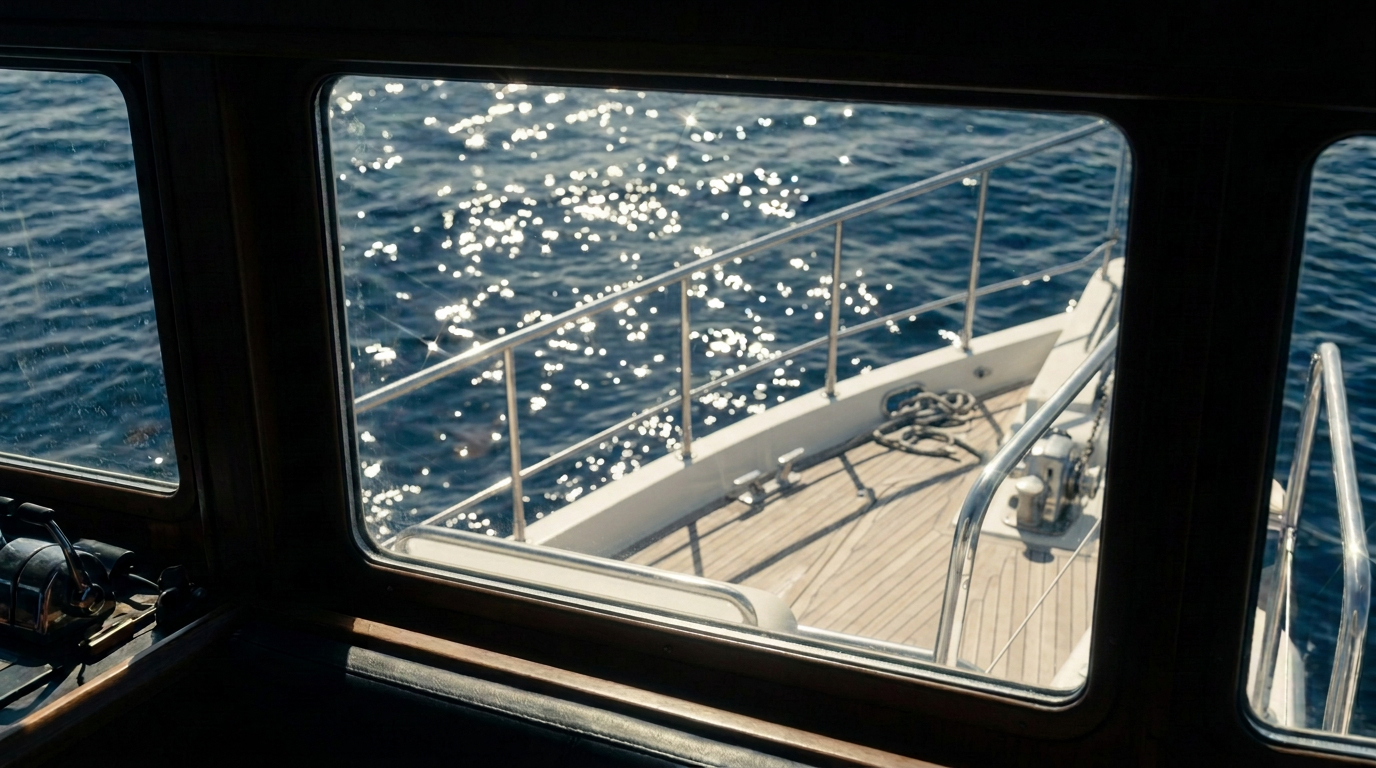
[Image 1] Defines the wooden cabin structure, window frames, deck, and ocean surface.
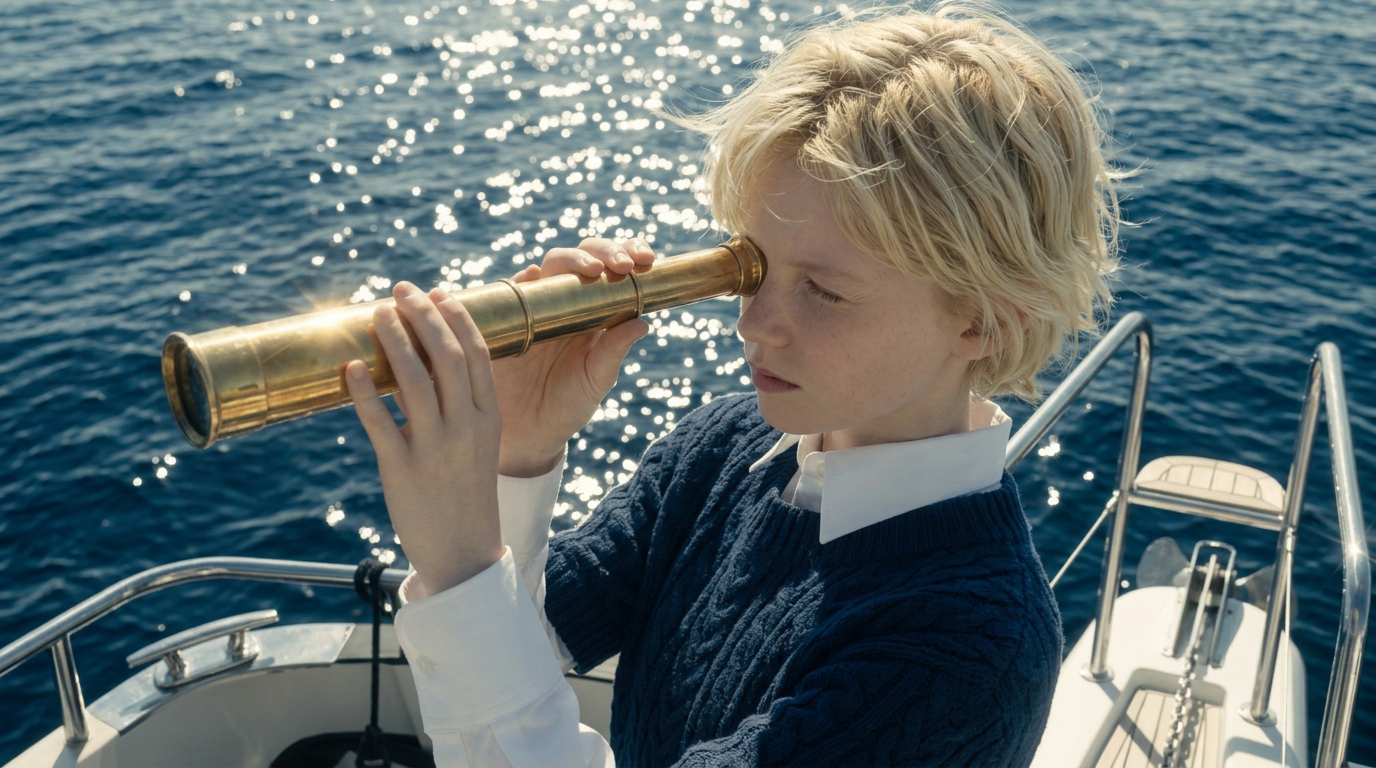
[Image 2] Defines the lead's short blonde hair, facial features, dark blue knit sweater, white undershirt, and brass monocular telescope. The lead is a young adult man, wearing dark straight-leg trousers below the waist. All character appearances, clothing, product details, and ship structural elements remain 100% consistent across the entire video.
No text of any kind appears on the hull, cabin, deck, or cabin windows: no ship names, identification numbers, lettering, signage, or brand logos.
The opening camera is positioned inside the cabin, filming the exterior deck through the window. The lead walks away from the camera toward the railing, keeping his back to the cabin interior and facing the open sea. Only the back of his head, his back, and his arms resting on the railing are visible at this point. His face is only revealed after the cut to the exterior off-front deck shot, with 100% continuity maintained for his stance and facing direction.
All passengers introduced in the opening cabin scene remain on the vessel for the full runtime. During the final pullback shot, the same passengers are visible through the cabin windows, seated chatting and gesturing naturally, while the lead on the deck continues to wave. Cabin windows stay transparent, with preserved dark interior detail and minimal, subtle glass reflection. The final pulled-back framing stops at a distance where the lead and active passengers inside the cabin are still clearly distinguishable.
Exactly three adult tourists appear on the shore: a young man in a light casual shirt and dark trousers leans on the railing looking out to sea, while the other two stand beside him chatting casually. The number of people, their outfits, and their positions stay perfectly consistent across all shots.
The unassisted naked-eye distant view only shows the sea, island shore, and boardwalk outlines: no red dots, tiny unidentifiable human figures, or waving movements appear at this stage. The three tourists only become clearly distinguishable after the second push-in through the telescope.
The featured product is strictly the brass extendable monocular telescope shown in @image2: it has a single tube, single eyepiece, and matches the exact proportions and structure of the reference. When collapsed, it is stored in the lead's right trousers pocket, with the pocket opening and the exposed top edge of the closed tube clearly visible.
The sequence of retrieving the telescope is shot as one continuous, unbroken take: the tube is pulled fully out of the pocket along the actual pocket opening, and only extended once completely removed. The tube maintains its collapsed full length during extraction, extends fully in one smooth motion, and is lifted to the eye in a single continuous movement.
The observation sequence is split into two forward push-in segments, with a short tight close-up of the hand twisting the eyepiece for fine adjustment inserted between them. Both first-person subjective views through the telescope remain fixed on the exact same section of island shore, with the second push-in continuing seamlessly from the exact framing and magnification level where the first push-in ended. During adjustment, the telescope remains held steady at the eye, with zero change to the direction the tube is pointed.
The lead maintains his original facing direction the entire time, with no camera orbiting movement. A stable high-angle slightly overhead medium shot of him lifting the telescope is preserved. The final pullback moves diagonally backward and upward continuously, framing the ship’s rail as a diagonal line and capturing the lead in a clear 2/3 profile.
No character dialogue appears anywhere in the full video; only two specified short English voiceover lines play in the later segment, each spoken once with zero synchronized lip movement. English on-screen subtitles only appear while their corresponding voiceover line plays, displaying one line at a time, and fade away immediately after each line finishes. The final static frame contains no text, brand names, logos, or watermarks at all.
[Visuals, Cinematography & Physical Motion]
Natural daylight, deep blue ocean, warm brass color grading, and subtle fine film grain. Soft highlights, layered shadow detail, with crisp, clear rendering of skin texture, knit fabric weave, and product seam lines.
A subtle consumer DV aesthetic is achieved via natural slight camera drift, organic follow focus, and snappy electric zoom movements. Every zoom has a distinct clear start, acceleration, and full stop, with a short natural pause at the end for the viewer to observe the scene. A very brief, natural moment of minor focus hesitation is allowed, after which the main subject snaps perfectly into sharp focus.
Minor natural motion blur is permitted for walking movements, head turns, seagull tracking shots, and waving actions; all shots of retrieving the telescope, hand adjustment motions, product close-ups, and critical view-through-the-telescope actions remain perfectly sharp.
Daylight illuminates the scene from a high side angle, casting realistic soft shadows around the lead's eyes when he raises his hand to shade them. Subtle soft reflections off the ocean surface gently lift shadow detail on his face, preserving full facial dimensionality.
Sea breeze is sustained at 3–4 m/s, with brief gusts reaching 5 m/s, blowing through the lead's short hair, shifting his collar and cuffs. The ship rocks gently and steadily, with the lead and camera moving with a very slight, consistent, natural synchronized sway that matches the vessel's movement.
[Music & Sound Design]
Upbeat, lightly swinging instrumental jazz: featuring bright piano phrases, plucked double bass, soft light brush drum work, and a small number of mellow brass stabs. The track follows a clear structure: opening entry, brief rhythmic acceleration, intentional quiet negative space, and a relaxed, resolving closing phrase.
The audio opens with dense ambient chatter, laughter, and the soft clink of tableware from inside the cabin. As the lead walks out onto the deck, interior voices gradually fade into the background, the sound of sea wind and rolling waves comes to the forefront, and the jazz rhythm begins to unfold.
The two hard cuts following the opening establishing shot are each paired with a soft, crisp mechanical shutter sound, timed perfectly to hit music beat markers. The soft metallic click of the telescope tube extending lands exactly on a beat, and the motion of lifting the telescope to the eye is paired with a single clean, distinct musical accent.
The two telescope push-in sequences follow a cohesive sonic rhythm: the first push-in is paired with a short ascending piano run. When the shot cuts to the hand adjusting the lens, the jazz pulls back briefly to leave a quiet gap, highlighting the subtle fine metallic friction sound of the adjustment. The second push-in is paired with a brighter, more prominent piano response, which resolves cleanly the exact moment the three tourists come into sharp focus.
When the young man on the shore notices the ship and waves, the percussion pulls back slightly, and the piano melody continues under the shot of the lead on the ship smiling and waving back. The two people on the shore continue their conversation with natural lip movement and gestures, with no discernible intelligible dialogue.
The voiceover uses a warm, relaxed adult male voice, delivered in a calm, unrushed tone with a faint natural, friendly smile. There is a natural, unforced pause between the two lines, with the total combined voiceover runtime at approximately 4–5 seconds.
When the voiceover begins, the jazz track dips gently in volume, while the ambient sea wind and wave sounds remain clearly audible. After the second voiceover line finishes and the subtitle fades out, the piano plays a short closing cadence. Subtle ambient sea wind and wave sounds persist through the final static frame, before the audio fades out naturally.
[Shot 1 | Bustling cabin, lead's back visible through the window]
Set the scene using @image1 as the exact reference environment. The camera is positioned deep inside the cabin, capturing a wide, expansive long shot.
Multiple passengers fill the foreground, chatting with one another: some turn their bodies to respond to conversation, others raise drinking glasses, with their shoulders, backs, and hand gestures occasionally brushing the edges of the frame. The shot holds on this full, lived-in scene long enough for the cabin's ambient chatter and spatial feel to register, with no rushed early cuts. Foreground passengers are held slightly out of focus, while the central wooden window and the deck outside gradually sharpen into clear view.
Through the central wooden window, the lead walks out of the cabin door onto the exterior deck, moving away from the camera toward the railing. He keeps his back fully turned to the cabin interior, facing the open ocean the entire time.
The young man stops at the railing, resting both hands on the top rail. Through the window, the back of his short blonde-haired head, the back panel of his dark blue knit sweater, his white undershirt cuffs, and his arms on the railing are all clearly visible, with the expanse of the sea stretching out in front of him.
After a short natural pause, the shot cuts to an exterior close-up of his hands as they relax and lower slightly, paired with the first soft mechanical shutter sound. Cabin chatter fades fully away, and the sound of sea wind takes over.
[Shot 2 | Seagull B-roll, follow focus pulling to the sea surface]
The cut to the ocean outside the deck lands with the second soft mechanical shutter sound.
The edge of the nearby railing is briefly in sharp focus, before the focus shifts smoothly to a seagull gliding high above the waves. The camera pans gently and maintains continuous follow focus in the direction of the seagull's flight, allowing the bird to glide smoothly across the frame from one side to the other.
Subtle natural motion blur trails behind the ocean wave ripples and the seagull's wingtips as it moves, while the seagull's body stays fully recognizable. Ambient sea wind, wave sounds, and distant seagull calls build an open, expansive atmosphere.
After the seagull flies out of frame, the shot holds briefly on the same patch of sea and distant shoreline, before cutting to the shot of the lead observing the coastal scenery.
[Shot 3 | Admiring the view, shading his eyes]
The camera cuts to the off-front position outside the ship's rail. The lead maintains the exact same stance and facing direction he held in the opening cabin shot, and his face is now fully visible for the first time.
The off-front medium close-up frames his shoulder line, his hands resting on the railing, and the ocean in the background. The young man leans slightly forward, shoulders relaxed, as he quietly takes in the scenery. The breeze blows through the short hair on his forehead and makes his white cuffs shift gently.
He gazes out at the distant waterfront boardwalk, keeping his left hand anchored on the railing while he raises his right hand above his eyebrows, palm facing downward, to block the sunlight from his eyes.
The shot cuts to a tight 2/3 profile close-up. He squints softly under the shadow cast by his hand, tilting his chin slightly forward as he tries to make out fine details on the distant shore.
Unable to clearly make out the details, he lowers his shading hand and reaches directly toward his right trousers pocket.
[Shot 4 | Uninterrupted retrieval, extend, high-angle shot of lifting the telescope]
The camera follows his hand down to his hip, holding steady to frame the pocket and both of his hands clearly. The pocket opening is fully in view, with the very top of the collapsed telescope tube peeking out above the fabric.
His left hand gently holds the outer edge of the pocket opening, while his right hand grips the exposed top of the telescope tube, pulling it smoothly and completely upward out of the pocket. The pocket fabric stretches slightly with the movement as the product is gradually revealed, until it is fully removed from the pocket. This entire sequence is shot as one continuous take with no jump cuts that hide the movement behind obscured framing.
His left hand takes firm hold of the main telescope body, while his right hand extends the sliding tube fully in one smooth motion and stops. The brass texture and all seam lines are perfectly sharp, with the soft metallic extension click landing exactly on a music beat.
The shot cuts to a stable 45-degree high-angle medium shot framing the young man, the deck and railing, and the ocean in the background. Holding his stance, he lifts the telescope from his chest up to his eye in one single, continuous motion.
Just before the telescope presses firmly to his face, the shot transitions seamlessly into an off-front close-up: the brass telescope tube leads the viewer's eye to the area around his eye, wind blows through his short blonde hair, and the textless wooden cabin and window frame in the background are held slightly soft but clearly discernible.
As soon as the telescope is pressed firmly to his eye, the perspective cuts directly into the first-person view through the lens.
[Shot 5 | Two push-in segments, with inserted hand adjustment close-up]
First Push-In:
First-person subjective view through the monocular, with a single soft circular vignetting edge framing the view.
The opening frame includes a portion of the sea and the full, uncompressed distant view of the island shore. The camera performs a first short, snappy DV-style push-in focused on the exact same waterfront boardwalk, as the island shore moves from far to near, with the boardwalk, light-colored railing, and coastal rocks gradually becoming sharper.
After the push-in completes, the shot holds steady for a short pause. At this point, the general location of the boardwalk is clear, but the tourists’ faces and specific actions are not yet distinguishable. One light-colored vertical support post on the boardwalk is positioned on the right half of the frame, acting as the precise composition reference point for the second push-in.
Hand Adjustment Close-Up:
The cut jumps directly back to the ship, with a close off-front shot of the telescope still held steadily at the lead's eye.
His left hand supports the main body of the telescope, while the pads of his right fingers gently twist the eyepiece to make one small, precise fine adjustment, then stop. Only the local adjustable eyepiece section rotates; the full telescope tube remains perfectly pointed at the original island shore location, with no large shifting motion or repeated sliding extension movements.
The close-up focus locks onto the point where his fingertip touches the brass surface, the thin, narrow seam on the eyepiece, and the moving specular metallic highlight. The very edges of the frame capture a faint hint of his eyelashes, short blonde hair, and white shirt cuff, with the background cabin rendered with soft, out-of-focus bokeh. The subtle fine metallic friction sound of the adjustment is clearly audible.
Second Push-In:
The exact moment his fingers finish the adjustment, the shot cuts seamlessly back to the first-person telescope perspective, pointed in the identical direction.
The opening frame matches the exact view from the end of the first push-in: the exact same stretch of boardwalk, the same right-side light-colored support post, identical orientation, and identical magnification level. The view continues pushing forward for the second short, sharp zoom, never reverting back to the original wide distant starting perspective.
This second push-in narrows the field of view directly onto the three adult tourists standing beside the boardwalk. A very brief, natural focus adjustment moment is allowed, after which the tourists' clothing, facial expressions, and hand movements all become perfectly sharp. The shot holds steady for a short period to give the viewer time to register their reactions.
The young man in the light shirt and dark trousers rests one hand on the railing, while the other two people beside him stand at an angle to one another, chatting casually.
The young man first glances naturally to his left along the coastal scenery, then turns his head to the right to look out across the sea. When his gaze lands on the ship, his head and eyes freeze for a brief pause, before he breaks into a relaxed, easy smile.
He lifts his free hand and waves casually twice toward the ship, keeping his other hand resting on the railing the entire time. The other two people keep chatting uninterrupted, with no simultaneous head turn or waving motion.
The shot then cuts back to the lead on the ship.
[Shot 6 | Product close-up, synchronized voiceover and subtitles, final text-free static frame after pullback]
The lead sees the other young man wave, and his face breaks into a natural, easy smile.
An off-front close-up captures the motion of him lowering the telescope. The tube drops down below his chest, his left hand maintains a firm hold on the main body, while his right hand releases its grip.
The product and his hands sit center-right in the frame, with the soft, dim deep blue of the ocean filling the negative space on the left. The shot holds for a short moment on the product close-up, with the full brass tube, extendable telescoping structure, and front objective lens all fully visible. His white shirt cuff and the dark blue knit sweater create a clear, contrasting material backdrop.
The jazz track dips gently in volume, and the first English voiceover line plays:
“See a little farther.”
While the line is spoken, a single line of white text appears in the lower-left negative space over the deep blue sea: SEE A LITTLE FARTHER. As soon as the first line finishes, the subtitle fades out and disappears completely.
From the side facing the cabin window, the camera moves diagonally backward along the exterior of the ship's rail, slowly rising in altitude as the shot widens to frame the lead's full upper body, leaving ample empty space above his head and in the direction he waves.
The young man grips the telescope in his left hand, lifting his right arm up over his shoulder, raising his hand near the top of his head to wave broadly back toward the shore. He smiles directly at the people on the shore, with his arm's movement creating natural, gentle swaying in his upper body.
As his smile and returning wave are fully visible to the viewer, the second voiceover line plays:
“Feel a little closer.”
While this line plays, the subtitle appears in the exact same lower-left position: FEEL A LITTLE CLOSER. The first line is no longer visible, and only this second line is on screen. Immediately after the second line finishes speaking, the subtitle fades out and vanishes completely.
The camera continues to pull further back, gradually revealing the full deck, the railing, and the entire cabin structure. Through the cabin windows, the same passengers from the opening scene are still visible seated, chatting, turning to respond to one another, and lifting their hands in natural conversational gestures. The lead on the deck keeps waving back.
Once the full ship is framed in the shot, the vessel maintains a prominent enough portion of the frame that the audience can still clearly make out the waving young man and the active passengers inside the cabin. The characters naturally appear smaller as the camera pulls away, but their positions and total count stay perfectly consistent and continuous.
One or two distant seagulls glide past the outer side of the ship. The vessel sails steadily across the deep blue ocean, leaving a long thin white wake trailing behind it.
The final frame forms a slightly diagonally composed wide panoramic shot of the ocean, capturing the full ship, the young man waving on the deck, passengers visible through the cabin windows, the deep blue sea, and seagulls in the sky. At this point, all subtitles have fully disappeared.
The full frame freezes for approximately 1 second at the exact moment the lead's waving posture looks natural, the seagulls are positioned outside the ship's hull, and the overall composition feels perfectly balanced. The characters, ship, ocean, and seagulls all hold static, preserving the original color grading and fine film grain texture. The final image contains no text, brand names, logos, or borders of any kind.
The closing jazz cadence, paired with subtle ambient sea wind and wave sounds, continues through the full static frame before fading out naturally.
[Subtitle Presentation Rules]
Subtitles are exclusively paired with the two English voiceover lines, displaying exactly one line at a time:
SEE A LITTLE FARTHER.
FEEL A LITTLE CLOSER.
The first line disappears as soon as its voiceover finishes, and the second line only appears once the second voiceover begins. The two lines never appear simultaneously, are never stacked vertically, and are not left on screen as a permanent end tagline. The final static frame contains zero text of any kind.
Subtitles use a clean, legible white sans-serif font at a moderate, easily readable weight, with a very subtle dark drop shadow to guarantee strong, distinct contrast between the text and the deep blue ocean background. Font weight is never thin enough to become unreadable, with no heavy outline strokes or large opaque subtitle background boxes used.
Subtitles are positioned in the lower-left negative space over the ocean, placed intentionally outside of bright reflection areas, and never overlapping the lead, his hands, or the telescope. Full safe margins are preserved. Subtitles stay fixed in their absolute position on the screen at all times, never shifting position as the camera moves or shrinking with the rest of the scene as the ship recedes into the distance.
Each full subtitle line fades smoothly in and out, with no typewriter effect, bouncing, flying, or scrolling animation. English spelling is 100% accurate, with no Chinese text or any other extra characters added anywhere.
參考素材
參考素材會按原順序載入你的帳號。用於具體專案時,請確認你有相應的素材使用權限。
繼續探索

案例影片與原始提示詞來自字節跳動。這些是官方展示,並非 HolyCrab 生成或獨立測評的結果。不同生成可能得到不同結果。 字節跳動原始文件 ↗