Fly over Tokyo | A Broomstick Night Flight
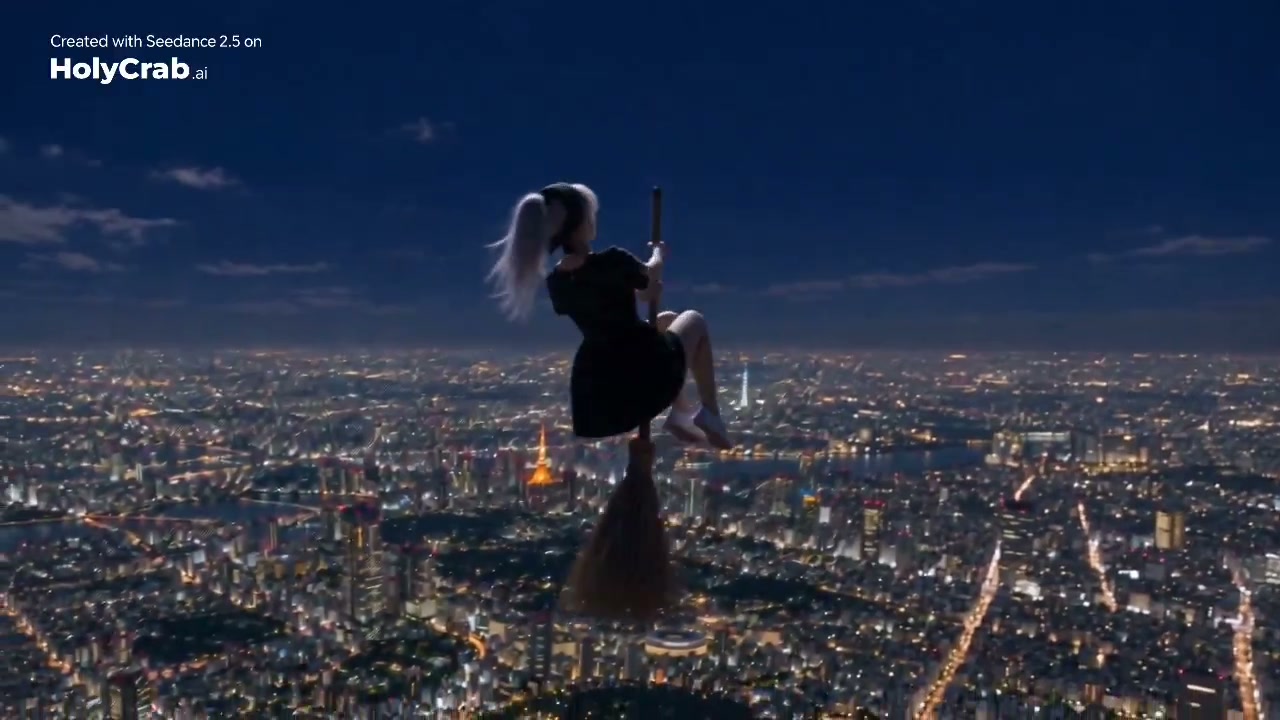
A HolyCrab original broomstick flight across Tokyo: full film, six reference images and a continuous-shot Seedance 2.5 production prompt.
The idea / HolyCrab Studio
From an idea to an original film.
A HolyCrab original: a white-haired rider flashes a V sign, flies through Tokyo's night streets, alleys and Shibuya Crossing, then climbs above the city. Explore the complete film, six references and the 28-second continuous-shot production prompt.
28-second continuous-shot production prompt
The featured film is the user's complete 30.05-second landscape video, retaining its audio, watermark and brand ending. The production prompt accompanies the latest local references and allocates 28 seconds to the action.
Fly over Tokyo | A Broomstick Night Flight

[Character, prop and reference roles]
@Image 1 is the sole identity and wardrobe reference. Keep the same 22-year-old adult Japanese woman, face and adult proportions throughout: silver-white high ponytail with loose facial strands, narrow dark-green headscarf, dark-green short one-piece dress with matching safety shorts, white low-top canvas shoes and one natural wooden broom with a straw brush. Do not inherit the studio background, studio lighting, standing pose or still composition.

No bow, backpack, handbag, shoulder bag, waist bag or straps.

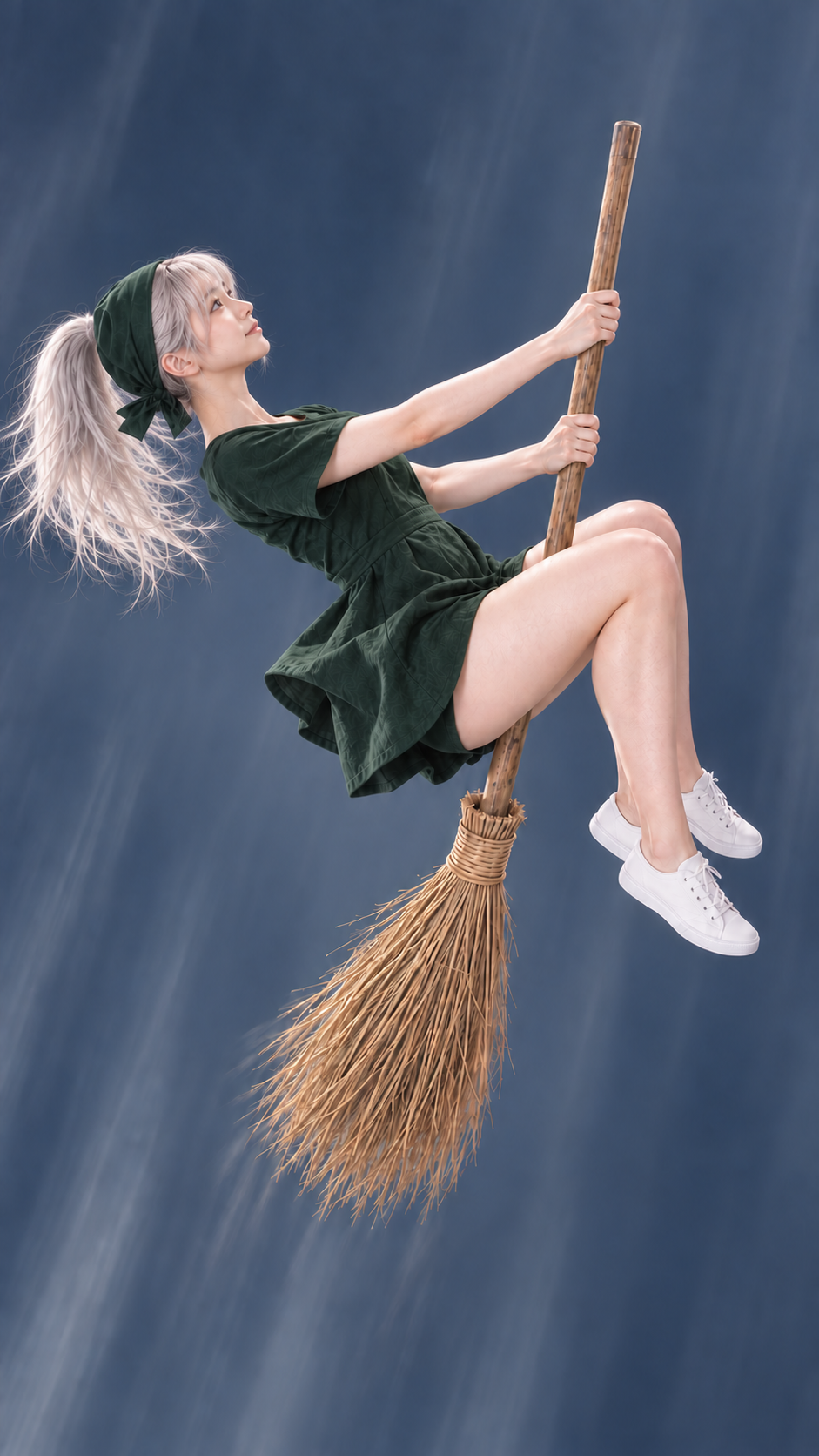
@Image 2 defines the seated riding contact during 0–18 seconds and the opening gesture during 0–1 second. Her pelvis sits on the same support point on the shaft. The shaft passes between her thighs; each thigh stays on its own side and grips it. Knees bend and lower legs tuck naturally backward; the brush trails behind her hips. Only during 0–0.7 seconds use the playful expression and right-hand YEAH/V sign beside her face. At about 0.7 seconds that hand returns to the shaft;

from 1 second onward both hands grip it. Omit studio lighting, grey background and a static floating appearance. This reference does not set the climbing angle at 18–25 seconds or pull the steep climbing pose back to horizontal.

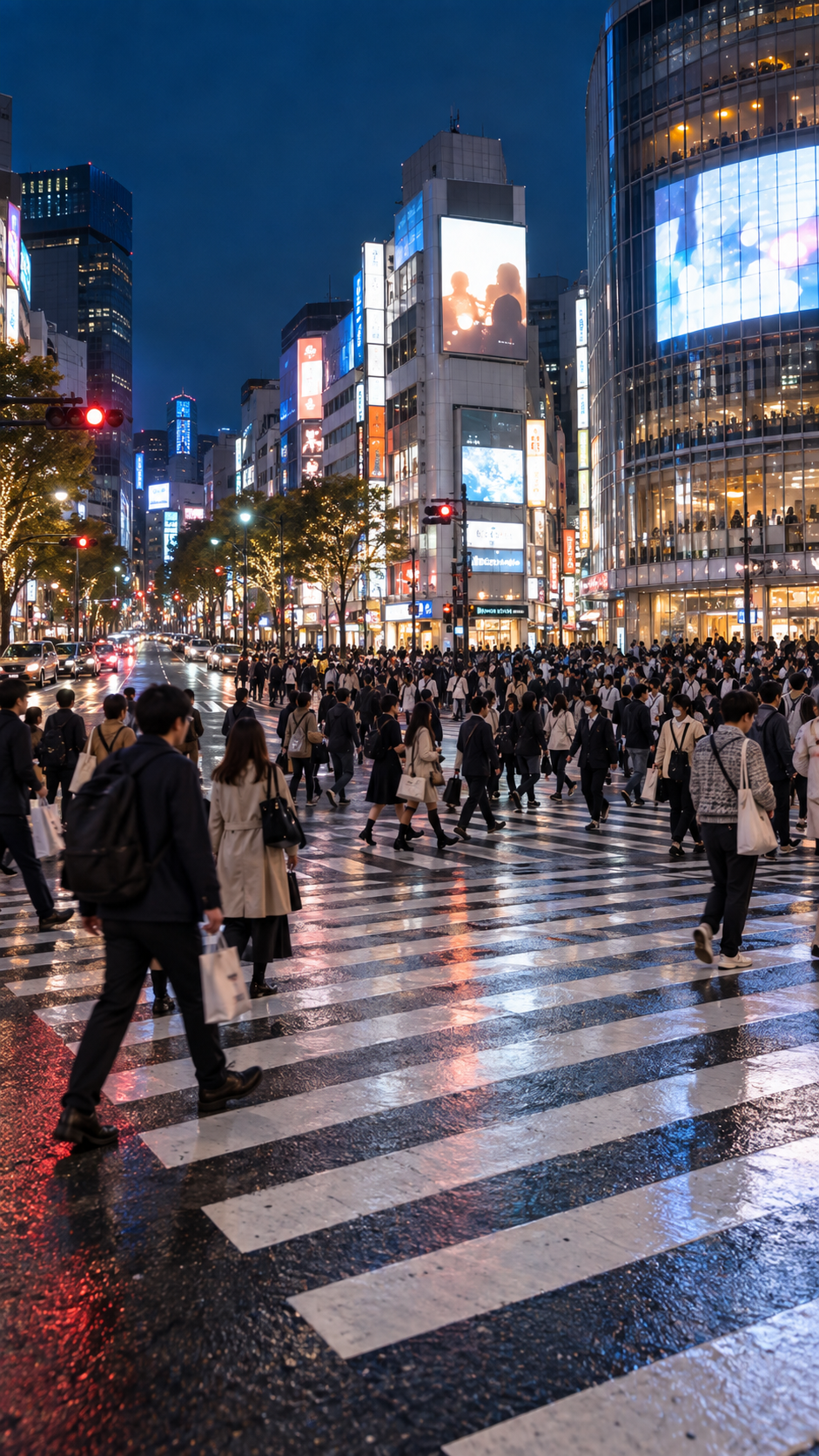
@Image 3 defines Tokyo's Shibuya Scramble Crossing: broad multidirectional zebra crossings, dense night-time pedestrians, modern buildings, wet pavement, streetlights, shop windows, screens, headlights and mixed city light. Use only environment type, materials, light-source positions and color temperatures, crowd density and scale. Do not copy specific pedestrians or make any of them a featured character. Shop signs need not be legible.

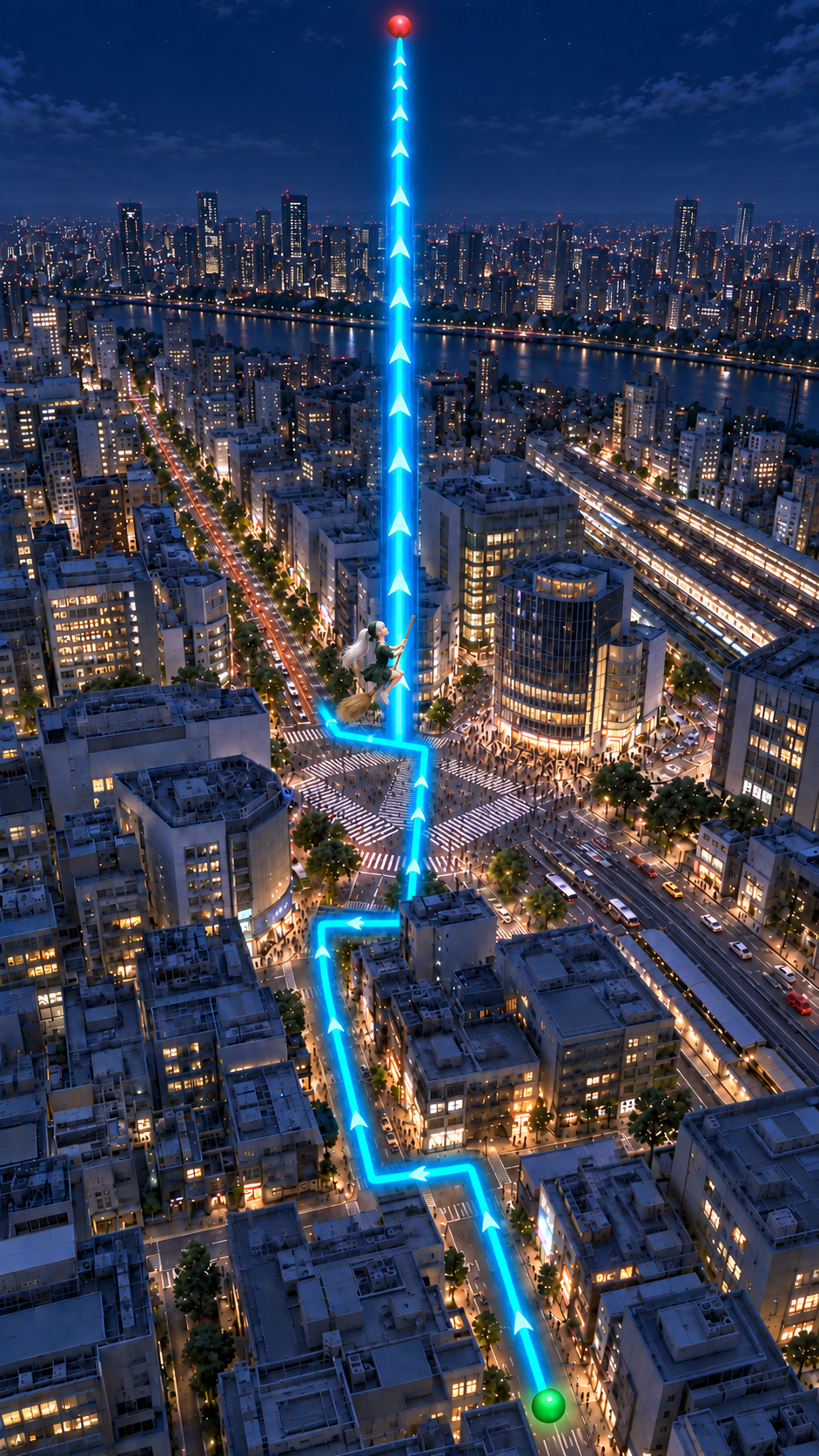
@Image 4 is the sole spatial route reference. Follow the single connected cyan line from green start to red finish: straight; right at an ordinary junction; straight; left into an alley; straight through the alley; right onto a main street; straight; left at busy Shibuya Crossing; straight to the takeoff point at 18 seconds; then climb through one nearly straight vertical corridor to about 1,000 meters. No ground-level S curves, weaving, slaloms, loops or U-turns.

No ascending spiral, circuits, lateral orbit, reversal or fork. The line defines topology, not speed; follow the timeline for speed. Never show navigation lines, arrows, spheres, miniature figures or map graphics in the film. Map buildings are scale placeholders, not architecture, lighting or identity references.

@Image 5 is the highest-priority riding geometry reference during the fast climb at 18.7–25 seconds. The broom points about 75–82 degrees above horizontal, the shaft's front points up along the flight direction, and the brush sits below and slightly behind the pelvis. Her seated weight remains on the same shaft contact above the straw binding.

The shaft continuously passes between her legs, thighs grip it, knees bend inward, and feet stay suspended without standing on the broom. From the hips, pelvis, abdomen, ribcage, shoulders, neck and head lean backward as one stable whole. The torso is about 35–45 degrees above horizontal and about 35–50 degrees from the near-vertical shaft. Shoulders and head remain behind the pelvis.

Keep a natural, nearly straight spine and engaged abdomen, without arching the lower back or bending the neck backward on its own. Chin lifts slightly and gaze follows the shaft's front toward the sky and flight direction, never the lens. Both hands firmly hold the same shaft at separated heights with visible wood between them. Each hand has five normal fingers; thumbs oppose the remaining fingers around the cylinder.

No fused, missing, repeated or penetrating fingers, and no broken or reversed wrists. The reference view explains the pose; she does not spin to match it while the FPV camera orbits. Omit its background, speed lines, bright figure lighting and still composition.

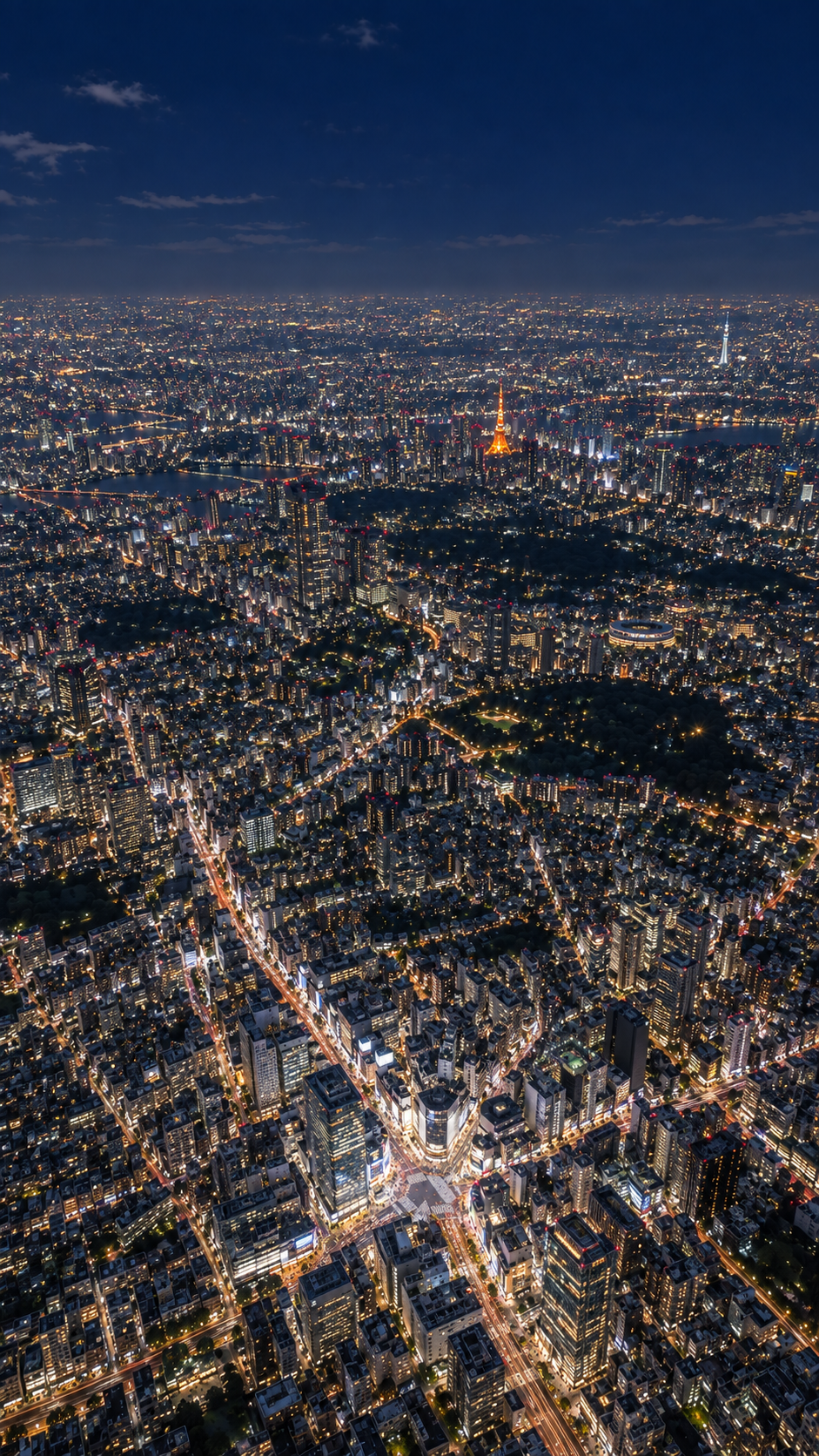
@Image 6 defines only the city extent, dense lights, atmospheric perspective, distant horizon and extreme aerial scale at about 1,000 meters. It is not a new scene to cut to, nor a pose or character-lighting reference. Arrive by continuously shrinking and revealing the same Tokyo district. Show only one real orange-red lattice Tokyo Tower, without copies, mirror images, ghosting or a second tower on screens, glass or the skyline.

[Highest priority: riding contact and one continuous take]
Rider and broom remain one inseparable riding assembly. Her pelvis stays pressed to the same shaft contact, the shaft remains between her legs, and her thighs keep their grip. They translate, turn, bank, pitch, climb, decelerate and level together. Contact points never slide, detach or swap; the shaft does not slide inside her body. Use @Image 2's near-horizontal riding pose during 0–18 seconds.

During 18–18.7 seconds rider and broom pitch together into @Image 5's steep climbing pose. Lock that relative geometry during 18.7–25 seconds. During 25–26 seconds level the whole assembly together, then hold a stable horizontal seated pose during 26–28 seconds.

One high-speed FPV camera tracks continuously around the combined center of rider and broom. Its orbit never makes her spin, turn her head or track the lens. Use one unbroken take: no cuts, inserted close-ups, axis jumps, time jumps or teleportation; no whip pans, occlusions, flashes, blackouts, heavy defocus or excessive blur to hide transitions. The camera never passes through the woman, broom, hair, walls, pedestrians, vehicles, signs or buildings.

Show no drone, propellers, drone shadow or second drone.

[Lighting and exposure: fixed world-space sources]
No camera lights, drone lights, studio key, ring light, invisible moving fill, unmotivated rim light or AI relighting. Sources remain in Tokyo world space: practical streetlights, shop windows, screens, traffic signals, headlights, wet-ground reflections, very weak night-sky ambience and city bounce from below. When the FPV changes viewpoint, lights do not rotate with it. Backlit or occluded surfaces naturally darken, with correct self-shadow on body, hair, dress and broom.

During 0–18 seconds, passing each practical source continuously changes light color, direction, intensity, highlights and shadows on white hair, face, arms, dress, legs and broom according to real distance. Turns change which body surfaces receive light. Buildings, door frames, signs and her own body cast moving occlusion and shadows. Exposure and white balance adapt slowly, without flicker, pumping or sudden face brightening.

During 18–20 seconds nearby streetlights and screens briefly retain directional influence, then their illumination visibly falls as she gains height. Colored neon does not freeze onto her skin. During 20–23 seconds, while she clears rooftops at peak speed, ground sources reduce to very weak broad bounce from below. She grows darker with altitude; white hair never emits light.

During 23–26 seconds expose for city lights and sky, leaving her roughly 1.5–2 stops below the city light grid as a readable riding silhouette. The dress becomes almost black-green; upward surfaces receive only faint cool-blue sky ambience and downward surfaces even weaker warm city bounce. During 26–28 seconds no nearby fixture, building or aircraft illuminates her.

Her back faces camera and is about two stops below the city lights, with only weak cool values on hair, scarf and shoulders; back and dress stay deeply dark, and legs, shoes, hands and broom are mostly shadowed.

No subject-following or face-priority exposure, HDR shadow lifting, local tone mapping, subject masks, recovered shadows, glowing skin or hair, white halos, holy light, false moonlight or darkening the whole city to reveal clothing. Tokyo Tower is never her key, fill or rim light.

[0–1 seconds: close-up and YEAH]
Start on an ordinary Tokyo night street. She is already seated correctly as in @Image 2, broom nearly horizontal, about 1.2 meters above wet pavement and facing down the road. The FPV is 0.7–1 meter away at a front three-quarter angle, making a small continuous arc around face and right hand. She smiles playfully, looks into the lens for about half a second and shows a clear right-hand YEAH/V sign beside her face. Her left hand holds the shaft in front.

At about 0.7 seconds the right returns to the shaft without changing pelvis or thigh contact; the broom stays 0–5 degrees above horizontal and accelerates gently forward. By 1 second both hands grip the shaft and the camera is physically retreating, without a cut.

[1–2 seconds: first straight]
The camera retreats smoothly to a wide full-body tracking view. She flies low and straight down the street center. Clearly show seated weight, thighs around the shaft, bent knees, tucked lower legs and brush behind. End at the first ordinary junction entrance, ready to turn right.

[2–4 seconds: right turn]
The complete rider-and-broom assembly makes one clear continuous 90-degree right turn with a natural radius, never cutting diagonally across it. The FPV follows the turn while continuing its orbit. End aligned with the second street.

[4–6 seconds: second straight]
Fly straight along the street center at about 1.5 meters, with only tiny stabilization corrections. No weaving or curves. End with the narrow alley entrance clearly visible on the left.

[6–8 seconds: left into the alley]
Make a clear 90-degree left turn and align with the alley. Tighten the camera's lateral offset to a physically passable side or upper-side elliptical arc. No passing through walls or signs. End centered in the alley.

[8–10 seconds: alley straight]
Fly straight along the alley center without slaloms or S curves. Warm shop-light pools alternate with dark gaps and create changing practical illumination. End with the main-street exit clearly visible to the right.

[10–12 seconds: right out of the alley]
Make a continuous 90-degree right onto the broad main street. Smoothly widen the FPV orbit, without using shadows or door frames to cut. End facing along the main road toward Shibuya.

[12–14 seconds: main-street straight]
Fly straight along the main-street center, rising smoothly from about 1.5 to 4 meters to clear obstacles, without starting the high-altitude climb. Shibuya's crossings and dense crowds approach. End at the Scramble Crossing entrance with vehicles safely behind signal lines.

[14–16 seconds: left at Shibuya]
Make one clear 90-degree left about 4 meters above the busy crossing. Pedestrians naturally look up but stay orderly; no collisions, falls or trampling. The open intersection permits the widest ground-stage camera orbit, without an inserted aerial shot. End aligned with the new street leaving the junction.

[16–18 seconds: final straight to takeoff]
Accelerate straight along that street, broom about 0–5 degrees, torso upright and height about 4 meters. Do not start the climb or any circuit early. The orbiting FPV keeps her whole body, broom and sky ahead visible. At 18 seconds reach the @Image 4 takeoff point, seated and gripping as in @Image 2, with strong forward momentum ready to curve into the vertical corridor.

[18–20 seconds: enter the steep climb and accelerate]
At 18 seconds the inseparable assembly smoothly redirects its forward velocity into a nearly vertical ascent along a short rounded path. Begin upward acceleration immediately, from the second frame after 18 seconds. During 18–18.7 seconds pitch rider and broom together, reaching @Image 5 and a 75–82-degree shaft by 18.7 seconds. She does not backflip and the broom does not rotate through her body.

Thereafter preserve the exact contact, thigh grip, bent knees, suspended feet, straight backward-leaning torso, head and shoulders behind pelvis, upward-forward gaze and separated five-finger hand grips. Continue smooth acceleration until the single peak speed at 20 seconds. Height rises continuously from about 4 to 180 meters. End above most roofs, stable in the same ascending corridor.

[20–23 seconds: hold peak ascent speed for three seconds]
Hold the highest upward speed for the full three seconds along @Image 4's same straight vertical corridor. No further acceleration, early braking, circling or sideways movement. Preserve @Image 5's relative geometry frame by frame: seated support, thigh grip, torso lean, gaze and grips. Only hair, scarf tails, skirt and bristles respond to strong relative airflow downward. Buildings and thin clouds stream downward with the strongest parallax and background blur.

The camera alone traces a narrow helical tracking path around her; rider and broom do not spin. Rise continuously from about 180 to 730 meters. End still climbing fast, with the rider markedly darker and the city lights clear.

[23–26 seconds: decelerate smoothly and level at 1,000 meters]
Begin braking only at 23 seconds. During 23–25 seconds reduce upward speed smoothly in the same straight corridor, keeping the 75–82-degree shaft and @Image 5 pose. No jolts, reacceleration or sideways drift. During 25–26 seconds complete the deceleration while rider and broom pitch forward together: shaft levels to about 0–5 degrees and torso returns upright without changing contact points. Upward speed continuously reaches zero.

The camera reduces angular speed and moves naturally to a slightly elevated position directly behind her. Rise from about 730 to 1,000 meters. At 26 seconds she is level and stationary, back toward camera.

[26–28 seconds: two-second rear-view aerial hold]
Hold the entire rider-and-broom assembly steady for the final two seconds at about 1,000 meters, without climbing, descending, moving forward or rotating. Broom stays 0–5 degrees, pelvis on the same support, thighs gripping and both hands in front. See only the back of her head, silver ponytail, scarf knot, shoulders, dress back, legs, white shoes and brush. No face, looking back, profile, lens contact or gestures. She looks toward Tokyo's horizon.

The FPV stays slightly above and directly behind her, allowing only slight stabilizing drift and a slow pullback, never orbiting to her side or front. Reveal @Image 6's expansive Tokyo night scale with tiny buildings and crossing below and at most one small orange-red Tokyo Tower. End naturally without freeze, fade or cut to black.

[Speed, camera and sound continuity]
One speed curve: low street flight during 0–18 seconds; smooth acceleration during 18–20; three full seconds at peak upward speed during 20–23; smooth deceleration to zero during 23–26; stable hover during 26–28. Parallax, motion blur, airflow in hair and clothes and wind sound follow this same curve. Wind grows during 18–20, stays at its strongest during 20–23 and fades with deceleration during 23–26.

Street sounds recede with altitude, leaving steady high-air wind and very distant city low frequencies in the hold. No drone motor, speech, narration or background music.

[Exclusions]
No old wide spiral, two-circle orbit, S-shaped route, rider spin, rotation around the shaft, axial broom roll, barrel roll, somersault, teleportation or jump cut. No standing on or aligning the body upright along the broom, pole hugging, climbing, hanging, lying prone, pelvis detachment or sliding, released thigh grip, feet on the shaft, brush between the thighs, shaft through flesh, arched lumbar spine, backbend, bridge, backflip preparation or isolated backward neck bend.

No malformed fingers, floating grips, extra limbs, doubled riders or brooms, black cat, wings, cape, hat, wand, jets, visible magic trail, bags, bows, subtitles, logos or watermarks.HolyCrab
Editor's note
The featured film is the user's complete 30.05-second landscape video, retaining its audio, watermark and brand ending. The production prompt accompanies the latest local references and allocates 28 seconds to the action.
Six reference images
Bind @Image 1–6 in order. Identity, seated riding, street setting, flight route, climbing pose and aerial destination each have a separate role.

Prompt breakdown

Establish the riding contact
Specify the seated support, shaft between the legs and hand grips. Rider and broom pitch together during takeoff, preserving contact throughout.
Use one continuous route
Fly straight, turn right, enter the alley left, exit right and turn left at Shibuya. The map supplies space, never visible navigation graphics.
Separate rider motion from camera motion
The FPV camera tracks around the rider-and-broom center while the rider keeps her heading. The latest plan uses a steep climb and ends behind her.
Keep light sources in the city
Practical streetlights, screens and headlights sweep over the rider as she passes. Their contribution falls during the climb, leaving weak sky and city bounce at altitude.
How to use this prompt
- Use the six numbers shown here: image 5 controls the climb pose; image 6 supplies the aerial environment.
- Identity and pose references show the same adult woman. Street and route references do not change her identity.
- The action prompt allocates 28 seconds; the complete featured film is 30.05 seconds. Set the desired output framing separately; the featured film is 16:9.
Seedance workflow
Seedance 2.5 Prompt Optimizer Skill
Download the Seedance-specific Skill for Codex to structure references, timing, camera movement, and audio more reliably.MiniMax H3